
by Melissa Donovan
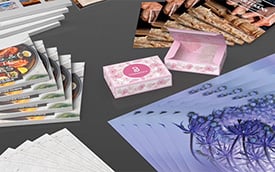
Sheet-fed/cutsheet inkjet technology is advancing at an impressive rate and branching out into various parts of the print industry. Today’s technologies are used in many segments like direct mail and marketing, commercial printing, book production, transactional, financial and insurance, packaging/folding cartons, and even photography.
Above: Canon’s sheet-fed inkjet presses deliver high quality across a range of media. For example, the Canon varioPRINT iX1700 features resolutions up to 1,200 dpi.
Turning to Cutsheet Inkjet
Adoption of sheet-fed inkjet is increasing across a range of customer segments and applications.
Early adopters, according to Peter Kowalczuk, EVP and client services group president, Canon U.S.A., Inc., “were primarily direct mail and transactional print customers, migrating communications with pre-printed offset shells and that had second step variable data printing on toner devices. These applications quickly transition to printing the entire communication on an inkjet press in one step.”
With advancements in print quality, especially on coated and uncoated papers, Kowalczuk says more commercial printers, book manufacturers, and customers in photo and high-end graphic segments turn to cutsheet inkjet.
Commercial printers also adopt sheet-fed inkjet as demand for variable data—including versioning and personalization—grows, notes Lance Martin, VP product marketing, Komori America.
It doesn’t matter whether cutsheet inkjet is used for direct mail or commercial printing—in all scenarios, Fred Morrone, senior manager – inkjet division, KYOCERA Document Solutions America, Inc., believes that the old model of toner and/or offset no longer works.
“Buyers want shorter runs, full color, faster turnaround, and personalization, all without paying a premium. The harsh reality is offset and toner-based systems cannot keep up. Customer expectations have changed,” comments Morrone.
He explains that inkjet fills a gap left by legacy devices that couldn’t handle these applications. In this way, inkjet allows print providers to profit from jobs they originally avoided or outsourced.
“In commercial print, it’s the ability to efficiently run short-volume work without setup waste or excessive labor. For publishers, they’re looking to add affordable color. On an inkjet press, doing all this is a piece of cake,” continues Morrone.
According to Tim Bolton, senior manager, inkjet technology portfolio, RICOH Graphic Communications, Ricoh USA, Inc., cutsheet inkjet offers several advantages that have to do with cost, performance, quality, and media versatility. “These mean more segments and applications adopting the technology.
“Inkjet is a lower overall cost to operate compared to a toner device. With regards to increased performance and print quality—concerns from the past around inkjet quality have significantly reduced with the advancements in inkjet technology. Inkjet quality can now compete with that of offset. Media versatility and ease of personalization capabilities have expanded opportunities for print offerings,” explains Bolton.
Between price hikes by the U.S. Postal Service and new tariffs, Andre D’Urbano, VP of sales, RISO Inc., believes print buyers and consequently print providers search for more economical ways of printing their messaging.
“Prices goes up, print volume goes down. And with smaller print volumes, come shorter run lengths. Consequently, the print strategy has changed dramatically for those operating production print centers. They can no longer afford a workflow of one or two larger presses to cover all jobs. Instead what is needed is six to 12 light production printers, multiple devices printing multiple jobs simultaneously in order to get as many jobs out in one shift,” explains D’Urbano.
Improvements Grow Reach
Cutsheet inkjet presses benefit from technological advancements on both the hardware and software side.
Hardware specific, Morrone says “image quality has improved, color stability is predictable, and duty cycles now include high- and short-volume tasks.”
Related to hardware is energy usage. Inkjet is favored over toner-based production devices because it typically uses less a energy, “primarily because they avoid the continuous high-temperature fusing process that toner requires. That tends to reduce both operating costs and environmental impact on electricity use,” explains D’Urbano.
Water-, oil-, and UV-based inkjet units are available. The majority are water-based devices and require a dryer and decurler to dry the ink on paper, says D’Urbano, so they still use heat but their electrical consumption is significantly lower than its toner counterparts.
Oil-based cutsheet inkjet uses less energy, according to D’Urbano. “This technology uses the absolute least amount of power compared to toner and its aqueous inkjet cousin. Oil-based ink is instant dry and uses a cold process that generates the type of flat output that is ideal for mailing inserters/folders. Oil-based pigment ink dries without the need of a dryer or decurler, which means smaller footprint as well as lower operating costs.”
In the realm of software, there are updates in automation and uptime, according to Morrone. “Faster startup, fewer maintenance call outs, reduced downtime, and more intuitive operation reduce dependency on highly specialized labor.”
“Upgraded RIPs and integrated software like Komori’s KHS-AI presetting software creates a better workflow for more uptime,” adds Martin.
Finally, media flexibility is growing and translating to more application variety per press. “Media flexibility enables printers to confidently run a broader range of applications, from transactional documents to commercial marketing pieces and books,” shares Morrone.
Proprietary technologies like Canon’s ColorGrip also play into the growth of media flexibility. “ColorGrip conditioning liquid is intelligently applied to imageable areas on the media where ink will be placed and enables high-quality output on a range of standard offset coated and uncoated papers,” says Kowalczuk.
Automation is another advancement. For example, the Heidelberg JetFire 75 features automated processes that take care of service and maintenance.
Hesitancy to Adopt
There are always hurdles to overcome when it comes to educating buyers on the benefits of am unfamiliar technology.
Cost can be a challenge. Many prospective buyers think an investment in inkjet cutsheet will be too high. “While it is true that inkjet solutions do typically come with a higher acquisition cost when compared to toner, operational costs over the life of the investment is often significantly reduced when compared to the same output on a toner-based device,” admits Bolton.
“Many commercial printers and in-plant operations want to transition to sheet-fed inkjet but lack the print volume necessary to justify the investment in a high-quality production press,” agrees Kowalczuk.
Those unfamiliar with inkjet may have a misguided perception of the technology as a whole, which challenges adoption. “Many print providers continue working with outdated technology and believe inkjet lacks quality, can’t handle demanding applications, or is only suitable for certain jobs. Those beliefs are not only wrong, but they are holding them back,” says Morrone.
For those immersed in offset, inkjet might raise some concerns. “Inkjet ink cost is higher compared to traditional offset inks, while zero makeready costs and zero makeready waste offsets require a new mindset. Offset remains optimal for long static runs and there may be coating and embellishment compatibility concerns,” comments Martin.
Adoption Rate
Cutsheet inkjet printers are used in various segments, especially as technology advances to meet the individual needs of each. As this occurs, the adoption rate accelerates.
“With increases in quality, reliability, and operational efficiency, sheet-fed inkjet is becoming more viable for nearly every segment. Applications in transactional, non-profit, solicitation mail, as well as direct mail and general commercial, all now have the ability to benefit from inkjet,” says Bolton.
Transactional documents with a short lifespan and stored or disposed of after use are also ideal for cutsheet inkjet, D’Urbano believes oil-based technologies serve these applications well.
“Oil-based inkjet provides the speed, productivity, and low operating costs that will generate incremental revenue and maintain high profit margins,” explains D’Urbano.
Martin believes adoption is also found in short- to mid-volume print. “Commercial printers profitably produce short-run work that previously fell below offset’s economic threshold.” This is especially true when the press is able to run offset-compatible substrates that reduce paper inventory, offers stable sheet transport for coated and uncoated stocks, and features UV LED ink that prints on offset and standard papers, no pretreatment needed.
The use of cutsheet inkjet in book publishing is expanding as well, primarily as “publishers shift to just-in-time manufacturing while maintaining professional print quality,” explains Martin.
The technology offers consistent color across reprints even from year to year; at the same time, presenting black-only inkjet body copy, which is very low cost and competitive, adds Martin.
Packaging and/or folding cartons are also a big adopter. With B2+ sheet size an option as well as superb front to back registration in single pass, “converters gain flexibility and speed without replacing offset for long-run work,” says Martin.
According to Morrone, “the way the industry is going, we’re seeing jobs getting shorter, more frequent, and more complex. Color is expected and personalization is standard. Inkjet aligns perfectly with these demands. That’s why adoption is growing quickly across all industries for sheet-fed inkjet.”
Here, There, Everywhere
The use of cutsheet/sheet-fed inkjet continues to increase across direct mail and marketing, commercial printing, book printing, transactional, financial and insurance, packaging/folding cartons, and photography—just to name a few segments. Speed and quality drive this adoption.
Mar2026, DPS Magazine


