by Cassandra Balentine
Across all segments, print providers face common challenges such as labor shortages, increasing job complexity, shorter run lengths, tighter turnaround times, and disconnected systems.
“Commercial and direct mail printers struggle to manage high job volumes and frequent changeovers, while in-plants are under pressure to reduce costs and improve transparency and service levels,” says Kevin Roman, director of professional services, Production Print Pro Services, Canon U.S.A., Inc. “Large and multi-location providers often lack standardization and real-time production visibility, creating inefficiencies and limiting scalability.”
Printers today face many challenges—faster turnaround times, rising order volumes, increased job complexity, multiple output formats, manual bottlenecks, inconsistent prepress processes, and integration limitations. “Each print business will have a unique mix of problems to solve,” admits Piet De Pauw, head of marketing, Enfocus, emphasizing the need for flexibility in automation software.
Breaking Down Silos
Many operations still have islands where estimating is separate from production, inventory separate from planning, and spreadsheets are everywhere.
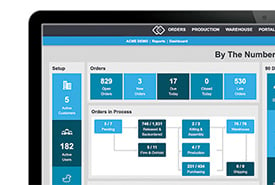
Data fragmentation and siloed systems are major production workflow challenges for modern print and packaging operations, especially those with multiple locations or legacy software. “When estimating, scheduling, production, inventory, and financial data live in separate systems—or worse, spreadsheets—teams lose real-time visibility into what’s actually happening on the shop floor,” says Mariusz Sosnowski, CEO, HiFlow Solutions.
Depending on a print provider’s current and long-term automation and integration goals, needs vary depending on the type of print business and/or amount of throughput, admits Marc Raad, president, Significans Automation.
For example, Rick Aberle, founder/CEO, Propago, notes that without automatic data flowing from storefront to production to fulfillment to billing, printers face excessive manual entry, duplicate records, and errors that slow production and damage client relationships.
David Graves, CEO, Aleyant, explains that a lot of workflow solutions involve scripting that can be burdensome and involve added personnel or outsourcing.
Hans Sep, product line manager, Fiery, points to a shift from scripting to visual flow-based design, which allows production managers to build and modify workflows without IT involvement. “This addresses the capabilities gap directly—the people who understand what needs to happen can now implement it themselves.”
Complexity at Scale
When brands demand more personalized materials, traditional workflows buckle. “As order volumes increase along with turnaround time expectations, many workflows are still held together by manual steps, emails, and last-minute checks that don’t scale,” adds Alex Bowell, managing director, Infigo.
Technical complexity also increases with personalization. “Managing dynamic variable data logic without specialized software becomes error prone and unmanageable at scale. Furthermore, a disconnect between sales channels and production systems often creates a disjointed workflow where orders from ecommerce portals must be manually re-entered into the MIS. This not only introduces typos and data discrepancies but slows down the entire operation,” cautions Dmitry Sevostyanov, CEO, Customer’s Canvas.
Mid-volume providers often rely on custom scripts and institutional knowledge, which also makes automation difficult to scale and increases operational risk. “Exception handling and rework frequently become bottlenecks,” comments Chris Odden, director, Digital Transformation & Integrated Solutions, Software & Strategic Solutions, Commercial & Industrial Printing Group, Ricoh USA.
Ben Parker, director of sales, Rochester Software Associates, finds that the biggest workflow challenges—like manual prepress and makeready bottlenecks, disconnected ordering systems and production workflows, labor shortages requiring higher automation, and integrating legacy transactional data into modern workflows—are mostly seen in high-volume, multi-device, and enterprise environments, but workflow solutions are used to help overcome these challenges.
Additional challenges may relate to governance, compliance, and system integration. “Managing multiple delivery channels from a single data source, integrating legacy platforms with modern workflows, and ensuring uptime and disaster recovery readiness are ongoing concerns,” comments Odden.
Nicole Miller, COO, Nordis Technologies, adds that growing security threats demand stringent digital and physical protocols and practices for data and record protection that must evolve to keep pace with changing risks, such as artificially intelligence-generated attacks.
Solving Challenges with Workflow
Print providers in all segments continue to evolve, accepting shorter runs, more complex orders, and demands to hit tighter turnaround times, this among a skilled labor shortage, increasing costs, and an uncertain economical climate.
The solution? Workflow automation, which starts with the integration of siloed systems to simplify production, reduce errors, eliminate waste, and improve productivity.
Mar2026, DPS Magazine