
by Melissa Donovan
When sourcing media for digitally printed folding carton production the type of ink used—water-based or UV inkjet in addition to toner—plays a pivotal role. A range of substrates are compatible with each technology but testing is important to determine the best material for the job. The appearance of the final print must match the customers’ vision and sometimes this means adding coatings—even barrier coatings—or embellishments like varnish or foil.
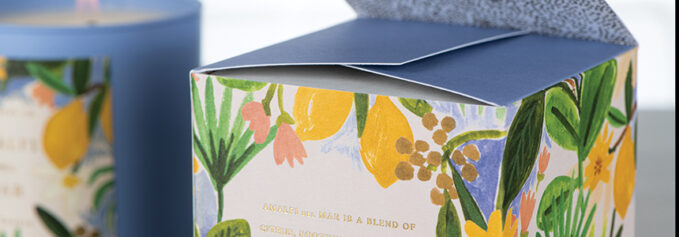
Above: All Neenah Folding Board Digital items are completely recyclable. While most print, foil, and decoration can also be recycled it is very specific to the actual embellishment.
Available Options
Popular folding carton options include paperboard like solid bleached sulfate board and folding box board. These may be comprised of recycled materials, include barrier coatings, or incorporate metallized variants. Most of these materials range from 200 to 600 microns in thickness.
Most are available for water-based and UV inkjet applications, but due absorption issues some require priming to ensure proper ink adhesion. “Inkjet technologies, both water-based and UV, typically demand greater surface porosity than traditional flexographic or lithographic inks. This is due to the differences in the ink vehicle system—conventional inks use more robust vehicles that carry pigments, waxes, and other additives, whereas inkjet inks rely on more limited vehicle systems that depend on absorption into the substrate,” notes Robert Waddington, product line leader, curing and drying, BW Converting.
“Water-based inkjet generally requires a coated or primer-treated board to control absorption. UV inkjet is more forgiving and handles a wider range, especially with surface treatment. At Xeikon, our dry toner presses print directly onto untreated board, up to 530 microns thick. This is possible thanks to low-temperature contact fusing, which preserves substrate integrity while delivering high-quality output,” says Kent Wolford, marketing director, Xeikon North America.
Mohawk offers folding boards crafted from virgin, recycled, and alternative fibers. Melissa Stevens, CMO, Mohawk/Fedrigoni Special Papers North America, says these are available in a palette of popular shades—white, kraft, and black—as well as a range of weights from 16pt to 24pt.
“These boards are thoughtfully designed to meet the creative and functional demands of designers and brands alike for both offset and digital printing,” explains Stevens.
Neenah Folding Board, known for its premium, uncoated offering includes three distinctive items specifically manufactured for digital presses. Bright White, 100 PC White, and Deep Black are all available in standard and B2 sizes. All three items are manufactured with Neenah’s proprietary Universal Digital Finish, ensuring compatibility with all digital presses. In addition, Neenah offers two C1S pearlized boards in White and Natural that are great options for toner/EP and digital foil embellishment.
Compatibility between press and folding carton media must be considered. Not every material works on every printer and vice versa. Certifications and media reports are helpful indicators.
Waddington suggests the FograCert PrintCheck as a relevant certification to look for in assessing inkjet media compatibility. It is commonly referenced and can serve as a benchmark when evaluating press/media combinations.
Not Alone
Media is only as good as the ink printed on it. The role of inks and coatings is important in folding cartons.
“They’re central. The ink or toner defines color intensity, food safety, and print durability. Xeikon’s dry toners, for instance, offer offset-quality color with food safe compliance and no odor—ideal for confectionery or cosmetics packaging. A protective overprint varnish adds scratch resistance for automated packing. In water-based inkjet, the right primer is essential to control dot gain and adhesion. UV inks cure instantly but require careful chemistry choices for sensitive applications,” explains Wolford.
For UV inks, Lance Martin, VP product marketing, Komori America, says the ink set produces durable and scratch-resistant output. In addition, UV LED cured inks exhibit a glossier finish, which may reduce or even eliminate the need for additional coatings depending on the application.
Water-based inks offer high print quality and a host of other advantages, according to Jochen Sproll, senior business development manager, Koenig & Bauer Durst. “The VariJET 106 uses water-based inkjet inks, primers, and coatings to provide the highest print quality at a most competitive cost level, while supporting current and upcoming food safety and sustainability regulation. The water-based inks are Swiss Ordinance compliant for food safety. Standard offset grade media can be used, with a primer coat applied before it reaches the inkjet engine.”
Waddington believes “inks and coatings are critical to the overall performance of digitally printed folding cartons. Proper selection directly impacts adhesion, visual quality, fold performance, embellishment compatibility, and recyclability.”
“The interaction between ink and media can either enhance or detract the graphic being applied to the package. Coatings can greatly enhance both the appearance or tactile qualities,” adds Stevens.
Interestingly, Jennifer Dietz, senior product manager, folding board and label, Neenah, a Mativ Brand, says that inks and coatings used for uncoated board are typically secondary to the actual finish of the material, which is the biggest draw.
“Depending on the art, an uncoated board can accentuate it—such as the watercolor image on the Neenah Rifle Candle box, drawing customers in by replicating the feel of the original painting. In another example, using the solid Neenah Deep Black board eliminates the need for flood coating, banishes white edges, and provides a premium luxe feel with simple decoration such as gold foil or white ink,” shares Dietz.
Barrier Coatings
A offshoot of coatings is a barrier coating, which is not necessary in every scenario.
Barrier coatings serve as a protective purpose. “Barrier coatings can be used for a range of reasons from moisture resistance, grease proofing, and UV protection to enhancing product safety and shelf life,” shares Sproll.
“Barrier coatings are appropriate anytime resistance to penetration of a particular element is required—water, water vapor, oxygen, or aroma. These can be applied by the media manufacturer or the packaging converter,” notes Stevens.
Wolford says barrier coatings are typically used in frozen food, snacks, or bakery cartons. “Today’s water-based or bio-based barriers can be applied offline via flexography or gravure, and many are repulpable—making them both functional and sustainable. It’s essential to test compatibility with your chosen digital print process, but Xeikon’s toner technology tolerates most barrier layers without compromise,” he continues.
While barrier coatings are beneficial, since they enhance packaging functionality, Waddington suggests they be considered separately from inkjet primers. “Some barrier coatings also support recyclability goals, particularly those designed for delamination or improved deinking, and may work in tandem with washable inks, though digital versions of these inks remain limited.”
Finish it Off
Embellishments like varnish and foil are attractive, used as a way for a packaging piece to standout on the shelf. It’s predictable that folding cartons would be affected by this trend.
Foil is often used on Neenah’s uncoated board. Dietz says it provides a sophisticated elegance.
“When it comes to varnish on uncoated, many printers will use it to ‘seal’ the surface when using heavy coverage or four-color process, to help protect from scuffing or ink offsetting—a common practice in commercial printing as well. The point to make clear to the designers and brands looking to achieve specific effects is that a varnish will not show up on an uncoated board. To get the shiny contrast you would need to use a clear foil,” explains Dietz.
According to Stevens, Mohawk Folding Board supports a wide array of print finishing techniques, including letterpress, foil stamping, and engraving. “For optimal results, it is recommended that you collaborate closely with your print partner and conduct thorough testing to ensure the paper performs to your expectations,” she offers.
To ensure the embellishment applies properly, the surface of the folding carton media is critical and of course so is the ink or toner used. “Xeikon’s dry toner prints have excellent surface energy, so they’re compatible with most embellishments—whether it’s water-based or UV varnish, hot foil, cold foil, or even digital foil. Our Fusion Embellishment Unit allows converters to apply spot varnish, tactile varnish, and foil in perfect register to the print—all inline and without the need for priming. This unlocks high-impact packaging while reducing touchpoints,” notes Wolford.
Sproll says that the VariJET enables all-in-one production with inline embellishment using conventional Rapida coating stations and off-the-shelf consumables in B1 standard offset format.
“In the case of Komori’s J-throne 29, the use of UV LED cured inks provides a printed sheet with optimal surface energy or dyne level for common post-press embellishment using traditional methods. Komori has demonstrated that sheets printed on the J-throne 29 can be successfully coated using UV and aqueous common coatings,” shares Martin.
Challenges to Note
A common concern with folding cartons is cracking on the fold lines, especially if there is heavy ink coverage.
Depending on the media manufacturer, there are different ways to combat this. Mohawk “typically alters the fiber compositions of the base sheet and includes surface treatment materials to improve the durability and flexibility of folding carton media,” says Stevens.
Wolford believes there are three key factors to consider in terms of avoiding cracking—the ink/toner used, creasing technology, and board humidity.
“Using Xeikon’s dry toner, the image layer is ultra thin—around five microns—which allows the fibers in the material to flex naturally even under dense ink coverage. Secondly, converters should use a high-quality creasing technology like multi-channel rotary scoring or digital creasing systems to distribute stress in the fold. Finally, maintaining consistent board humidity during finishing helps prevent cracking along the grain,” says Wolford.
Scoring is definitely a culprit when it comes to cracking. “Fold cracking can be exacerbated by poor scoring. Good quality male-female scoring rule blades with properly adjusted cycle depths, matched to the stock thickness, will yield the best results,” adds Martin.
As Wolford alludes to, the technology of the printing press plays a role, like Xeikon’s dry toner and how it enables an ultra thin image.
The same is said of Koenig Bauer & Durst’s water-based technology with its feeding mechanisms and how they help prevent cracking. “Our sheet transport, feeding, delivery, press control, and makeready use existing Rapida technology and ensure highest quality production” says Sproll.
“From a UV ink formulation perspective, incorporating polyester resins into the formulation can significantly improve flexibility and reduce cracking,” explains Waddington.
Additionally, any topcoats or laminates used should be designed with flexibility in mind to ensure compatibility with the ink layer and the mechanical demands of folding, he suggests.
Recyclability of Folding Cartons
In a society where recycling and reuse is top of mind, this is a common request for buyers of digitally printed folding carton packaging. The media, ink, and coatings all impact recyclability. However, there are challenges with instituting this on a global scale.
Europeans are ahead of the U.S. in terms of recyclability mandates. “In Europe, the Packaging and Packaging Waste Regulation (PPWR) that came into force this year represents a significant regulatory intervention in the packaging market. With the primary goal being to reduce, reuse, and recycle packaging with the focus on promoting a functioning circular economy. PPWR is good for fiber-based packaging such as folding cartons,” explains Sproll.
“Regulations are evolving, by 2025, half of all plastics used in EU packaging must be recyclable, increasing demand for materials like rPET. As sustainability standards rise, innovations in washable inks and barrier technologies will likely accelerate,” admits Waddington.
Stevens believes the biggest impact on recyclability for folding carton applications regardless of the print applications is barrier coatings or film laminates. “This is a rapidly changing area with improvements in recyclability of barrier materials occurring in real time.”
A Reshaped Market
The folding carton market is evolving, and digital printing technologies play a role in this transformation.
“Digital printing is reshaping the folding carton market by enabling rapid, flexible, and sustainable production solutions,” says Sproll.
While it’s not a replacement for traditional methods, its role is growing, particularly for shorter runs, design flexibility, versioning, and agile production needs. “A large portion of folding carton converters see the future of the packaging industry as a hybrid approach, combining digital and conventional printing to balance cost, scale, and customization needs,” concludes Sproll.
Oct2025, DPS Magazine