
by Cassandra Balentine
The future of direct mail is personal—hyper personal and measurable. The latest direct mail trends are largely driven by the need to improve response rates and reduce labor, fueled by the introduction and adoption of the technologies that support it.
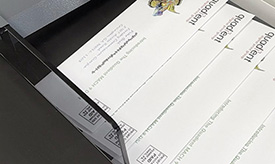
Above: Quadient’s Mach 9DS digital printing system with the MACH Symphony suite of software allows for complete full-color envelope customized printing with interactive technologies.
Brook Spaulding, BW Converting senior account manager, East Coast, W+D Brand, sees direct mail as far more tightly connected to digital engagement and data analytics than it ever has been. “Technologies like quick response (QR) codes, augmented reality (AR), personalized URLs, and campaign-level tracking are no longer optional add-ons. They’re becoming central to how marketers justify mail spend and prove performance.”
There is growing interest in advanced integrations like Near Field Communication (NFC) and other embedded components, especially for higher value campaigns. “These technologies allow mail to function as a true trigger within a broader omnichannel strategy rather than a standalone touchpoint,” says Spaulding.
The common thread is measurability. “Mailers want to know exactly how a piece performs once it leaves the plant, and integrated technologies are what make that possible. This shift is influencing everything from creative design to how equipment on the production floor is configured,” adds Spaulding.
Kevin Crawford, regional business development manager, Quadient Digital Print Group, feels that the value proposition for technology is labor savings through inline automation. “Labor is the highest fixed cost within an organization, and the ability to use automation to reallocate those valuable resources to higher value tasks is highly desirable.”
An added consideration, the U.S. Postal Service’s (USPS’) incentive programs. Among its 2026 promotions, USPS is offering a postal discount for qualified mailers that integrate digital technology—AR, NFC, video in print, and artificial intelligence—into physical mail to encourage engagement. Even deeper discounts are available with the inclusion of Informed Delivery.
Integrating Technology
Technology-enabled mail makes the most sense for targeted campaigns. “These formats are often tied to personalization and data segmentation, which naturally lends itself to smaller, more strategic volumes,” comments Spaulding. “This doesn’t mean you can’t run high volumes, but you need enough scale to justify setup, testing, and verification.”
Additionally, many campaigns succeed at moderate run lengths because the response rates are higher. “In other words, it’s less about hitting a magic number of pieces and more about aligning volume with campaign objectives and production efficiency,” shares Spaulding.
When it comes to the effect on production, Crawford explains that the impact of integrated technology on run speed is relative to the number of active background processes used and the processing power and memory buffer deployed to handle the workflow. “For example, Quadient’s Mach Symphony system has plenty of buffer processing to keep the accompanying mail inserting system operating at its top speed.”
When jobs are properly engineered the impact on speed and throughput can be minimal. The biggest issues tend to come from inconsistent materials or poor placement of technology elements, not from the technology itself. If a component interferes with feeding, folding, or sealing, it is seen immediately in yield loss or stoppages. “That’s why design for manufacturability is so important. A clean, repeatable mailpiece design almost always runs better than something that’s pushing the limits. The good news is that once a job is dialed in, it can often run just as efficiently as a conventional mailpiece. The key is investing time upfront rather than trying to fix problems at full production speed,” notes Spaulding.
Integrated Mail
Integrated mail technology is no longer a “nice to have.” It is an integral part of a well-managed marketing strategy that drives better response rates and maximizes postal incentives, states Crawford.
While technologies like printed electronics or video-in-print are still niche, Spaulding stresses that the equipment must be adaptable. “Even if a customer isn’t running those applications today, they want to know their investment won’t box them in tomorrow.”
Mar2026, DPS Magazine